







Nonlinear Books
April 19th, 2010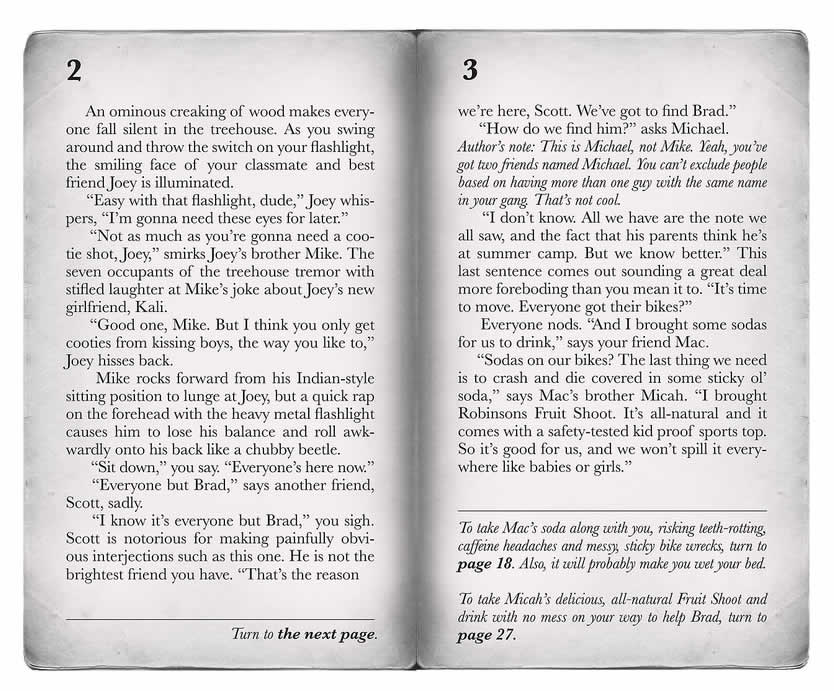
The other week while discussing the idea of narrative with Bob, he reminded me of the Choose Your Own Adventure books from the 80-90s. These types of books basically are written in a second-person point of view and readers are given choices requiring to flip back and forth throughout the book. As the plot unfolds, readers also may find themselves finishing with various types of endings, with some being less desirable than others. Looking for examples of CYOA books I also came across a superb narrative visualization project by Christian Swinehart. Christian analyzed a couple of these books and began comparing which pages are composed of pure story, decisions and endings.
What does all of this have to do with the remaining design artifacts scattered throughout this blog? I think books like these through their combined use of nonlinearity, choice and guidance raise a few interesting points around how our time based (flow) deliverables could potentially look like and behave. What if readers of our deliverables were guided through a set of predefined flows? What if the flows we design required readers to make choices in order to achieve multiple endings? On one end of the extreme spectrum we have passive documents such as wireframe decks where there is often a single thread of experience. Here we have guidance, but no choice as we flip from the first page till the end. On the other hand of the spectrum, we might have a fully interactive prototype. Here we have zero guidance and tons of choice (perhaps even too much). Could this more balanced combination of guidance and choice then be a more powerful means of conveying interaction and narrative in our field? I’d think so.
Credits: mewrite (flickr image), and Christian Swinehart (visualizations)
One Response to “Nonlinear Books”












November 30th, 2010 at 10:06 pm
How Interesting. I've been thinking of designing this type of 'read'. I love choices in video games. Dragon Age: Origins is a perfect example of a great game many moral choices which determine various outcomes or endings. It can be played from the pov of various characters (which in a book format would be difficult) but the moral choices are heavy and outcomes unknown which make the 'story line' enjoyable (non-linear).
We are now in at place where technology will allow 'book programs with choices' … devices such as the Kindle from Amazon, the various phones or even website featuring a certain genre –
The basic program 'book' can be purchased – downloaded to Kindle, Phone etc. for a small fee, BUT the choices also must be purchased – read through to the 'next choice/decision' again a purchase is made to continue.
Another thought a small ''sim/avatar' program can be added to 'create' the hero or heroine just for the fun of it.
Kids today can still be brought back to good ol' fashion reading as oppose to spending hours on gaming – I think it would be a beautiful marriage of reading and tech